
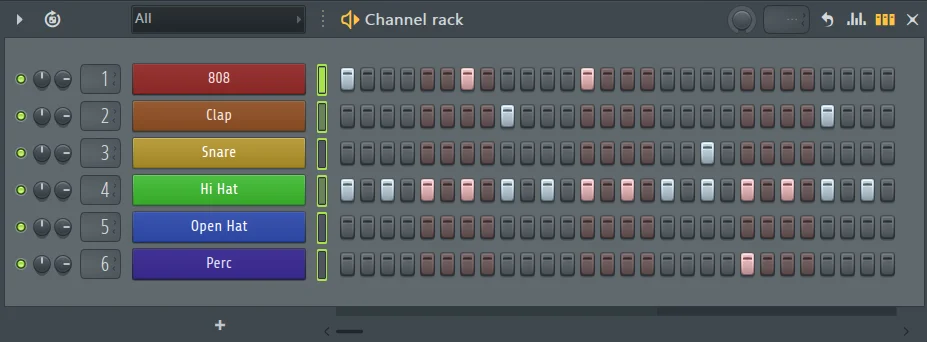
Drum patterns are essential in making trap beats. Most of us producers spend 90% of our time on the melody. The drums are an afterthought — a basic kick-snare loop they drop in and leave running through the whole track.
Then we wonder why the beat sounds flat, why it doesn’t groove, and why artists don’t want to record on it.
Here’s the truth: your trap drum patterns are the foundation everything else sits on. Get them right and every element of the beat clicks into place. Get them wrong and no melody, no 808, no mix trick is going to save you. Getting trap drum patterns right isn’t the hardest skill to develop, but it does require understanding how the groove actually works — not just where the kick and snare go, but why they go there and what you do to make the pattern feel alive instead of robotic.
This is the guide that covers all of it. From BPM and the halftime feel, to kick and snare placement, to hi-hat programming, velocity, swing, and building variation into your trap drum patterns. So without further ado, let’s get into it.
Setting Your BPM: Why Trap Drum Patterns Feel Slower Than They Are
Before you place a single note, you need to understand how tempo works in trap — because it’s different from most genres.
The average trap beat sits around 140 BPM, but can range anywhere from 120 to 160. That number on its own doesn’t tell the whole story. The reason trap drum patterns feel the way they do — heavy, spacious, almost slow in the pocket — is the halftime feel.
The Halftime Feel Explained
Trap uses a halftime drum pattern, with the kick sparse and spaced out while hi-hats run fast and urgent. The DAW is set to 140 BPM, but the kick and snare move at roughly half that pace — giving the impression of a beat at 70 BPM. Meanwhile, the hi-hats are running at full tempo with rolls and triplets, creating double-time urgency on top of a slow, heavy pulse.
The kicks are sparse and at half time, which gives the impression of about 70–75 BPM, and that’s what gives the hi-hats and snare fills their rushing, urgent energy against the slow pulse. That contrast — heavy slow foundation vs. fast hi-hat movement — is the signature feel behind all great trap drum patterns.
Set your project to 140 BPM as a starting point. If you want more energy and pace, push toward 150–160. For a heavier, more laid-back groove, pull it back toward 130–135.
How Do You Program Trap Kick Drum Patterns?
The kick is the heartbeat of the beat. It defines the pulse and creates the pocket that everything else — your 808, your hi-hats, your melody — locks into.
Start simple. Place a kick on beat 1 of every bar to establish the downbeat. That’s your foundation. From there, you build.
Building Beyond the Downbeat
Trap kick patterns live in the space between predictable and syncopated. Here’s the standard approach:
- Beat 1 — Kick always lands here. This is your anchor.
- Beat 2 — Optional additional kick for an early double-hit feel.
- Beat 3 — Traditionally where the snare lands in trap’s halftime feel, so leave space here.
- Beat 4 “and” — A kick right before beat 1 of the next bar creates momentum and pull.
From that skeleton, get creative with additional kicks between the main beats. Many producers place kicks just before beat 3, on the “and” of beat 2, or stacked as a double kick toward the end of a bar. These syncopated placements are what give trap drum patterns their groove and forward motion.
Syncopation: What Actually Creates the Groove
In trap drum patterns, the kick often doesn’t follow a simple one-beat pattern — it features offbeat placements that create a driving, syncopated rhythm. The groove isn’t in the kick hitting where people expect it. It’s in the kick hitting slightly where people don’t — creating tension and release that makes the beat feel alive.
Try this exercise: program the most basic kick pattern you can (kick on 1 and 3 only). Loop it and listen. Then start moving single hits one 16th note off — earlier or later. Hear how the groove shifts with each small change. That sensitivity is how you develop a feel for syncopated kick placement in your own trap drum patterns.
Trap Snare Placement: Where It Sits and How to Make It Hit
In trap’s halftime feel, the snare typically lands on beat 3 of each bar. This is the fundamental difference from regular hip-hop (where the snare hits on 2 and 4) and what gives trap drum patterns that heavy, slow pocket feel.
That’s your anchor. Everything else is variation.
Layering the Snare for Impact
A single snare sample is a starting point, not a finished snare. Layer a clap or a second snare sample underneath your main snare hit on the stronger beats. The clap adds width, brightness, and snap that a solo snare often lacks.
Place the layered sounds ever so slightly ahead of or behind the main snare hit — just a few milliseconds. This micro-offset gives the snare a fuller, more human feel compared to two sounds hitting at exactly the same grid point.
Adding Snare Variation
Once your main snare placement is locked in, use variation to keep your trap drum patterns from feeling like a loop. Triplet snare rolls at the ends of bars act as fills and transitions, creating that rapid-fire effect you hear between sections. A quick 32nd-note rush of snare hits in the last beat before bar 1 turns the pattern around and creates the feeling of momentum pushing into the next section.
What Makes a Trap Hi-Hat Pattern Work?
The hi-hat is where your personality as a producer lives in the drum pattern. Two producers can use the same kick and snare template and sound completely different based on how they program their hats — it’s often the fastest way to tell one producer’s trap drum patterns from another’s.
Start Simple, Then Build
Don’t start with the most complex hi-hat pattern you can think of. Start with closed hats on every 8th note — a steady, consistent foundation across your entire bar. That basic 8th-note pattern gives you something to build variation on top of.
From there:
- Switch some 8th notes to 16th notes in specific spots for double-time energy
- Add 32nd-note rolls — set your MIDI grid to 32nd notes and fill in rapid hits just before snare hits or at the end of a bar
- Drop in triplet sections — switch the grid to triplets and add fills toward the end of bars for that skipping, rushing feel producers know from Migos-era trap
Triplets: The Signature Trap Groove Element
If you’re not using triplets in your hi-hat patterns, you’re leaving the most distinctive element of trap percussion on the table. Triplets divide a beat into three equal parts instead of two, giving the groove a skipping feel that’s neither straight nor off-beat — it’s its own thing.
Switch your DAW grid to triplets (1/24 or 1/16T depending on your DAW), and place a cluster of triplet hats in the second half of a bar. Play back your pattern. That rushing, locking-in energy is what separates real trap drum patterns from a flat drum loop.
Use triplets sparingly. One or two placements per 4-bar loop is enough. If every hat is a triplet, nothing stands out.
How Do You Make Trap Drum Patterns Feel Less Robotic?
Every producer has made a beat that sounds mechanical — like a sequencer, not music. The reason trap drum patterns feel robotic is almost always the same: everything is at full velocity and perfectly on the grid. That’s not how rhythm actually feels to the human ear.
A real drummer never hits every note at the same force. That natural variation in dynamics is what makes a groove feel alive. Programming that variation into your drums is the move that separates good patterns from great ones.
Velocity Variation: The Most Important Fix
Velocity controls how hard each hit sounds. In trap hi-hat patterns especially, vary the velocity of each hit to add dynamics and prevent that robotic feel.
A practical approach for hi-hats: set your main 8th-note hits to around 80–90 velocity. Set the in-between 16th-note fills to 60–70. Set your 32nd-note rolls to build — start at 50 velocity and crescendo up to 90 as the roll approaches the snare. That crescendo through a roll makes it feel intentional and musical, not just technically fast.
For kicks and snares, even shifting the velocity of certain hits up or down slightly can do wonders. Your downbeat kick can sit at 100. An off-beat syncopated kick can drop to 75. That subtle difference gives your trap drum patterns weight where weight matters.
Swing: Shifting Off the Grid
Swing delays the second note in a pair, giving the rhythm a laid-back, shuffling feel instead of robotic machine-gun precision. In trap music, applying swing to your hi-hats gives the drums a more human feel.
Most DAWs have a swing or groove function built in. Start subtle — a 10–15% swing setting is usually enough to add feel without making the pattern sound sloppy. Try delaying every second or fourth hi-hat to get a swing feel. Even manually nudging notes a few ticks off the grid in the piano roll achieves this — you don’t need a plugin.
Ghost Notes: Adding Texture Under the Pattern
Ghost notes are quiet hits placed between the main beats — low velocity snares or hi-hats that you can barely hear individually, but that add complexity and groove when the full pattern plays. Use ghost notes to add complexity without overwhelming the main rhythm.
In practice: place low-velocity snare hits (velocity 35–50) on the “e” and “a” subdivisions between your main snare hits. They won’t be clearly audible — they add a subtle pocket-filling feel that makes your trap drum patterns breathe.
How Do You Build Variation into Trap Drum Patterns?
A four-bar drum loop that doesn’t change is a loop, not a pattern. The best trap drum patterns evolve — small shifts in the drums keep the listener engaged without them even noticing why.
The 4-8 Bar Rule
Create slight variations in your pattern every four or eight bars to keep listeners engaged. These don’t need to be dramatic. A few simple options:
- Drop out the kick for one bar — the absence hits harder than any extra sound
- Add a double kick at the end of a bar — two kicks hitting right before bar 1 creates a surging momentum
- Add an extra snare on an off-beat — breaks the predictability for one hit then returns to the groove
- Switch to all 16th-note hats for 2 bars during a hook — the density increase signals the section change
Grammy-winning producer Boi-1da’s general rule is to have something change in the beat every four bars, no matter how subtle. It’s not about reinventing your trap drum patterns constantly — it’s about giving the listener a sense of movement and progression.
Adding Percussion Layers
Once your kick, snare, and hi-hats are solid, add supporting percussion elements to give the beat more texture and dimension. Rimshots, claps, open hats, and shakers can all add movement without crowding the main pattern.
A common trap move: add an open hat on the second quarter hit of every second or fourth bar. It doesn’t disrupt the pattern — it adds a subtle rhythmic accent that gives trap drum patterns more flavor.
Keep percussion elements quieter than your main drums. They should support the groove without competing with the kick and snare for attention.
Common Trap Drum Pattern Mistakes to Fix Right Now
Starting too complex. Every producer wants their first pattern to be the most creative thing they’ve ever heard. Build the foundation first — kick, snare, basic hats — and add complexity from there. Simple trap drum patterns executed well beat complicated ones that don’t groove.
Everything at the same velocity. This is the fastest way to make a pattern sound robotic. Even small velocity differences — 10–15 points between your primary hits and secondary hits — make an enormous difference in how alive the groove feels.
No variation across the arrangement. If your verse and hook have identical drum patterns, the hook doesn’t hit harder when it arrives. Strip drums back in verses, add layers for the hook, and use the contrast to make the energy shift feel earned.
Skipping swing and ghost notes. These are the tools that add human feel to a mechanical medium. You don’t need to use them heavily — a subtle swing setting and a few ghost notes between your main hits transforms a robotic pattern into something that breathes.
Not listening in context. A kick that sounds massive in solo can disappear once the 808 comes in. Always evaluate your trap drum patterns with everything playing — that’s the only context that matters.
Conclusion: The Drums Are the Foundation — Build Them Right
Having solid trap drum patterns in your bag is what gives your beats a feel that artists want to work with. Great trap drum patterns don’t call attention to themselves — they make the 808 hit harder, the melody feel more powerful, and the whole beat move with intention.
The process: set your BPM and understand the halftime feel. Build your kick foundation with the downbeat anchor then add syncopation. Place the snare on beat 3, layer it, and add end-of-bar fills. Program your hi-hats from simple to complex — triplets and velocity variation are your best tools for shaping trap drum patterns with real character. Build in variation every four to eight bars.
Now open your DAW, build just the drums, and loop them for two minutes. If your trap drum patterns make you nod your head without a single melody or 808, they’re doing their job. That’s the standard.
Ready to build out your full production skills? Check out our guides on trap sound selection, trap 808 techniques, how to structure a trap beat, and how to mix trap beats — everything you need from first loop to finished record.